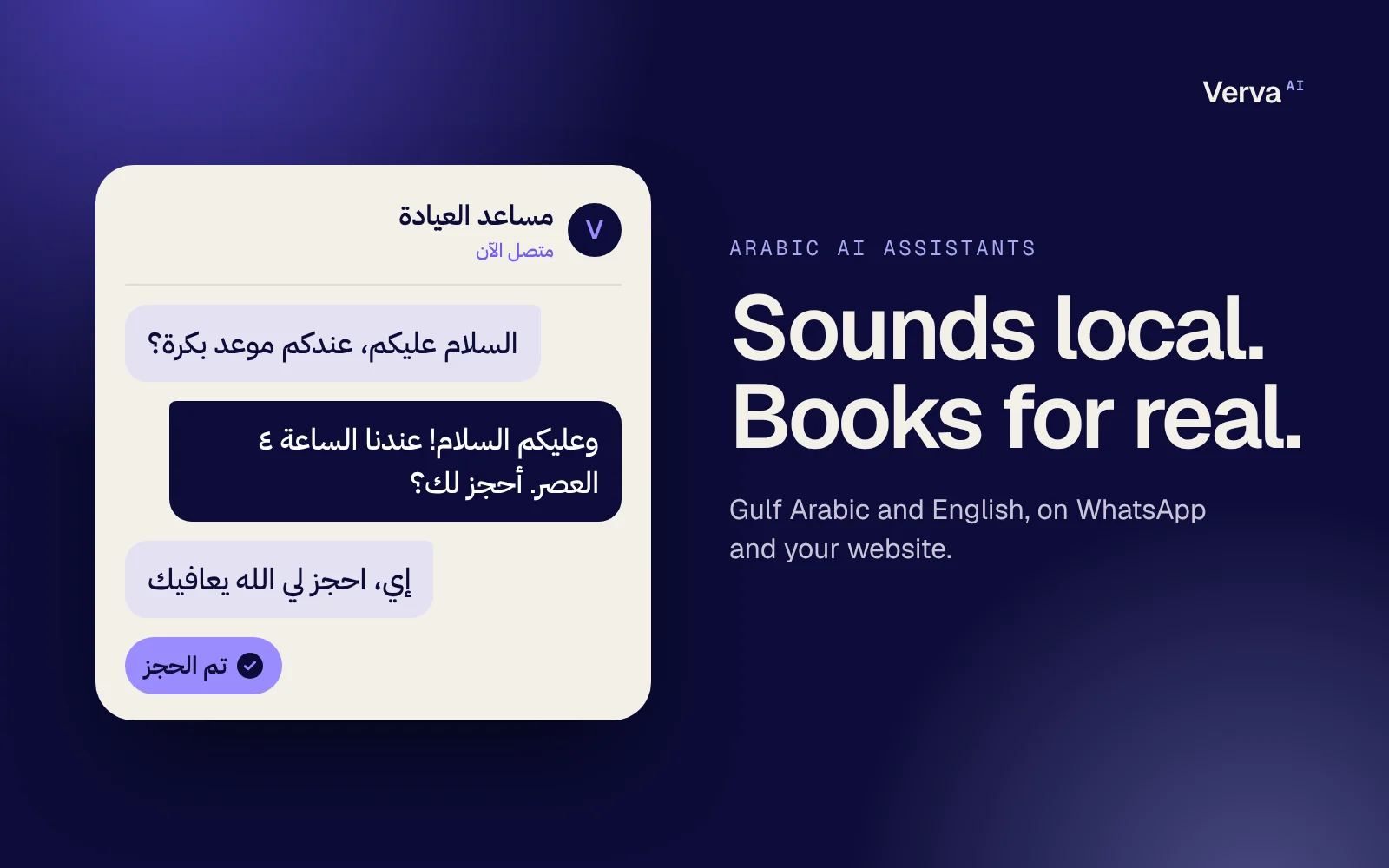
Why most Arabic chatbots fail
1. They speak the wrong Arabic
Modern Standard Arabic (MSA, or fusha) is what the news reads and what most AI models default to. Nobody messages a clinic in it. A customer in Dubai writes in Gulf dialect, an Egyptian expat in Egyptian, a Levantine customer in Levantine, and a bot replying in formal MSA sounds like a government form. It is understood, but it is not trusted.
2. They ignore mixed-language messages
Real UAE messages look like “hi, ممكن appointment بكرة الساعة 4؟” or “Salam, kam el price for the 2 bedroom?” Arabizi (Arabic written in Latin letters and numbers) is everywhere, especially on WhatsApp. A bot that only detects “Arabic or English” gets these wrong or replies in the wrong language.
3. The interface was never built for right-to-left
Website widgets with punctuation on the wrong side, buttons that read backwards, numbers that flip, bold formatting that breaks mid-word. Each one tells the customer the Arabic was an afterthought.
4. Translated content, not Arabic content
Running English FAQs through a translator produces answers that are technically correct and culturally flat. Greetings, politeness forms, how you address a woman versus a man, how you decline a request, when to use “inshallah” and when not to. These are not translation problems.
5. Nobody tested it with native speakers
The team that built it read English, checked the Arabic looked like Arabic, and shipped it.
6. The voice version is worse
Arabic text-to-speech defaults to MSA with a broadcast accent. Speech recognition trained on MSA mishears Gulf dialect. Voice agents fail faster than chat if the dialect is not handled.
How to do them right
Start with dialect, not language
Decide who the bot serves. In Dubai that usually means Gulf Arabic as the default with graceful handling of Egyptian and Levantine, since a large share of Arabic-speaking customers are expats. Modern AI models can do this if they are instructed and given examples, but it has to be designed in, and it has to be tested.
Detect language per message, including Arabizi and mixing
The assistant should read each message, work out the dominant language and script, and reply in a way that mirrors the customer. If they mix, it can mix. If they switch, it switches. If they write Arabizi, it replies in Arabic script with the option to continue in Latin letters, and notes which the customer prefers.
Write the Arabic content, do not translate it
Greetings, tone, politeness, gendered forms where the customer’s name makes it clear, and the specific phrasing your own staff use. Have a native speaker from the business review the top 50 answers. This is a day’s work and it is the single biggest difference between a bot people use and one they abandon.
Handle numbers, dates and names carefully
Prices in AED, dates in the format customers expect, phone numbers that do not flip in RTL layouts, and names transliterated the way the customer wrote them.
Build the interface for RTL from the start
The web widget switches direction per message, buttons and quick replies mirror correctly, and formatting is tested in Arabic. On WhatsApp this is mostly handled by the app, which is one reason WhatsApp-first works well in the UAE.
Test with native speakers before launch, in both chat and voice
Real past messages from your customers, a mix of dialects, Arabizi and mixed-language, and someone who will tell you honestly when it sounds wrong. For voice, listen to the TTS samples in Gulf Arabic and test recognition with real callers.
Keep a human in reach
Sensitive, emotional or complex conversations in Arabic should hand over to an Arabic-speaking colleague with the transcript attached. A bot that knows its limits is trusted more than one that bluffs.
What this costs
Not much more, if it is designed in from the start. English and Arabic are included in every Verva AI assistant, with Gulf Arabic phrasing tested before launch, and the website chatbot starts from AED 6,000. Retrofitting Arabic onto an English-only bot built elsewhere costs more and works less well, because the content and interface were never designed for it.
Book a free audit
and bring a few real Arabic messages from your customers. We will show you how the assistant handles them.